Benefits of College ERP
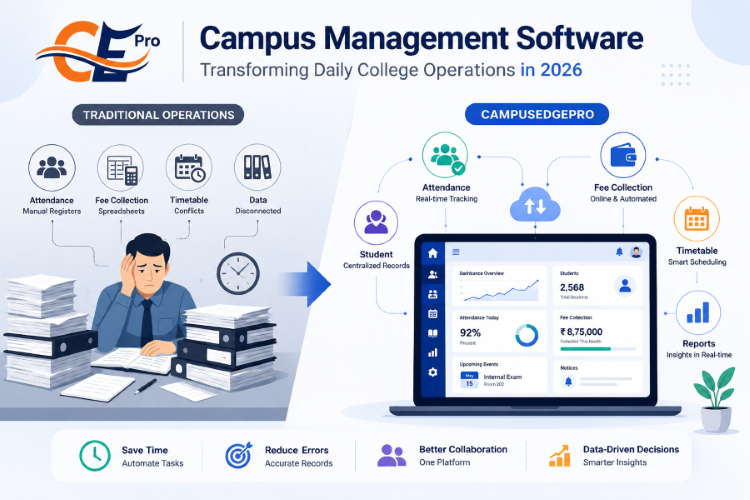
What Changes When Your Campus Runs on One System
If you work in a college office, you probably know this scene. The accountant has one spreadsheet, the admissions desk has another, and faculty hand in attendance registers at the end of the week. When the principal asks how many students have paid fees this semester, someone says “give us a day.”
A college ERP exists to end that. A system like CampusEdgePro is one piece of software that handles admissions, student records, fees, attendance, and reporting, so every department looks at the same information. In short, the benefits of a college ERP are fewer errors, less repeated work, and answers you can get in seconds instead of days.
Here is what that looks like in practice.
Student data lives in one place
Without an ERP, a student’s details get typed again at admission, again at fee counter, and again when the exam form comes around. Sooner or later two versions disagree, and then someone has to figure out which one is right.
With an ERP, the record is created once and follows the student from inquiry through admission, classes, fees, and eventually alumni status. Nobody retypes anything, and nobody argues over whose file is correct.
Fee collection stops being a monthly headache
Fees are usually the messiest part of college administration. There are different fee heads, installments, scholarships, late charges, and now online payments that have to be matched to the right student.
In an ERP you set up the fee structure once per course or batch. Receipts are generated automatically, online payments land in the right student ledger, and pending dues show up without anyone building a report. Accounts teams usually notice the difference at month end, when reconciliation takes hours instead of days. Parents notice it too, because there are far fewer “I already paid” disputes.
Attendance becomes something you can use
A paper register tells you who was present. It rarely tells you that a particular student has been slipping for three weeks, or that one subject always has half the class missing.
Digital attendance does. Faculty mark it quickly, and the system shows trends. That gives mentors a chance to talk to a student before a shortage becomes a problem at exam time.
Principals get real numbers, not last month’s report
Dashboards pull fee collection, attendance, and admission figures into one view. When a management meeting needs a number, it’s there. Decisions get made on what is happening now, not on whatever the office had time to compile.
Staff spend time on people, not paperwork
Copying data between sheets, calculating dues by hand, and sending reminders one at a time takes up a surprising share of an administrator’s week. Automating those jobs doesn’t replace staff. It lets them spend their time on things that need a human, like helping a confused first-year student or following up with a family in difficulty.
Communication gets easier
When everything is in one system, sending a fee reminder, an attendance alert, or a notice to the right group takes a few clicks. Students and parents can check their own status instead of queuing at the office.
Audit and accreditation work gets lighter
Whether you’re preparing for NAAC or submitting data for surveys like AISHE, you need records that are organized and accurate. If student, fee, and academic data already sit in one structured system, assembling that information is far less painful. An ERP won’t do the academic quality work for you, but it takes away a lot of the scramble.
Choosing a college ERP that fits
A few things are worth checking before you sign up for anything:
- Does it handle your real fee structure, including installments and scholarships?
- Was it built for Indian colleges, or adapted from something made elsewhere?
- Can non-technical staff learn it without weeks of training?
- Does it let you control who sees what?
- What do support and documentation look like after you go live?
The best test is a demo set up with your own courses and fee heads, not a generic walkthrough.
Frequently Asked Questions
1. What is the biggest benefit of a college ERP?
Having one reliable source of data for students, fees, and attendance. Most other benefits come from that.
2. Is an ERP only worth it for big universities?
No. Smaller colleges often benefit more, since they tend to run on spreadsheets with a small admin team.
3. How does a college ERP help with fees?
You configure fee heads and installments once, receipts are generated automatically, online payments are matched to student ledgers, and pending dues are always visible.
4. How long does it take to set up?
It depends on the size of your institute and how much existing data needs to move over. Many colleges start with admissions, fees, and attendance, then add other modules later.
5. Does an ERP help with accreditation?
It helps you keep clean, organized records, which makes preparing submissions easier. It supports the process, but it doesn’t replace the academic work behind it.
Where to go from here
If your office still depends on spreadsheets and registers, an ERP is probably the single change that removes the most daily friction. CampusEdgePro is a unified college ERP built for Indian higher education institutions, covering admissions, fee ledgers, attendance, and reports in one platform. You can book a live demo and see it set up around your own fee and course workflows.
Want to simplify campus operations?
Schedule a 1-on-1 walkthrough configured to your institute's fee and course workflows.